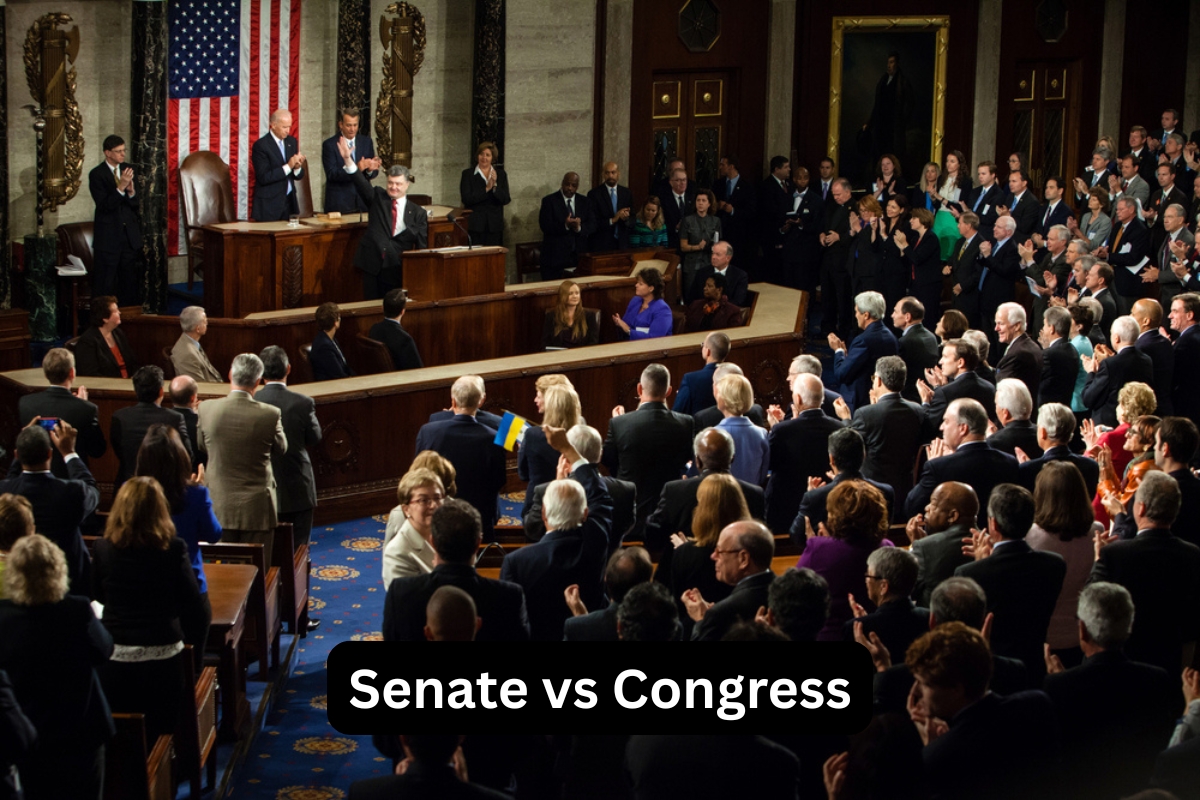
The terms “Senate” and “Congress” are often used interchangeably, but they are not the same. The U.S. Congress is the legislative branch of the federal government, consisting of two chambers:
- The Senate
- The House of Representatives
Here’s a detailed comparison of the Senate and Congress to clarify their roles, differences, and functions:
1. What Is Congress?
Congress is the bicameral (two-chambered) legislature of the United States, created by the U.S. Constitution under Article I. It is responsible for making federal laws, overseeing the government, and approving budgets.
Congress = Senate + House of Representatives
Main Powers of Congress:
✅ Pass federal laws
✅ Declare war
✅ Approve the federal budget
✅ Conduct oversight of the executive branch
✅ Propose constitutional amendments
2. The Senate (Upper Chamber of Congress)
The Senate is one of the two houses of Congress, often referred to as the upper chamber because of its unique responsibilities and longer terms for its members.
| Feature | Senate |
|---|---|
| Number of Members | 100 Senators (2 per state) |
| Term Length | 6 years (1/3 up for election every 2 years) |
| Representation | Equal representation (each state gets 2 senators) |
| Presiding Officer | Vice President of the U.S. (President of the Senate) |
| Special Powers | Confirms presidential appointments, ratifies treaties, conducts impeachment trials |
Key Responsibilities of the Senate:
- Approving Presidential Appointments: Senators vote on Supreme Court justices, Cabinet members, and federal judges.
- Treaty Ratification: A two-thirds vote is required to approve treaties.
- Impeachment Trials: The Senate conducts trials for impeached officials (the House brings impeachment charges).
Also Read: Congressman vs Senator
3. The House of Representatives (Lower Chamber of Congress)
The House of Representatives is the other chamber of Congress, often referred to as the lower house because it has more members and represents smaller districts rather than entire states.
| Feature | House of Representatives |
|---|---|
| Number of Members | 435 Representatives |
| Term Length | 2 years (entire House up for election every 2 years) |
| Representation | Based on state population |
| Presiding Officer | Speaker of the House |
| Special Powers | Initiates revenue bills, brings impeachment charges, elects the president in case of an Electoral College tie |
Key Responsibilities of the House:
- Initiating Revenue Bills: All tax-related legislation starts in the House.
- Impeachment Power: The House has the sole power to impeach the president and other federal officials.
- Electing the President (if necessary): If no candidate wins an Electoral College majority, the House elects the president.
4. Key Differences Between the Senate and the House
| Aspect | Senate | House of Representatives |
|---|---|---|
| Number of Members | 100 (2 per state) | 435 (varies by state population) |
| Term Length | 6 years | 2 years |
| Constituency | Entire state | Congressional district |
| Presiding Officer | Vice President (President of Senate) | Speaker of the House |
| Power in Impeachment | Holds impeachment trials | Brings impeachment charges |
| Role in Legislation | Approves bills, but focuses on foreign policy and confirmations | Initiates revenue bills, budget control |
| Filibuster? | Yes, allows unlimited debate (can be ended by a 60-vote cloture) | No filibuster allowed |
5. Summary: How the Senate and House Work Together
Even though the Senate and House of Representatives have different roles, they must cooperate to pass laws. Here’s how:
- Legislation Process: A bill must pass both the House and Senate before being sent to the president.
- Checks and Balances: The Senate oversees executive appointments while the House controls spending.
- Impeachment Process: The House impeaches, but the Senate decides the trial’s outcome.
Also Read: Senate vs House of Representatives
6. Why Do We Have Two Chambers?
The Founding Fathers created a bicameral system as a compromise between large and small states:
- Large states wanted representation based on population (House of Representatives).
- Small states wanted equal representation (Senate).
This was part of the Great Compromise of 1787, ensuring fairness and balance in representation.
Senate vs. Congress
The Senate is just one part of Congress, which also includes the House of Representatives. The Senate has more influence in foreign affairs and long-term policymaking, while the House is more responsive to the people due to its shorter terms and direct elections. Together, they form the legislative branch of the U.S. government.