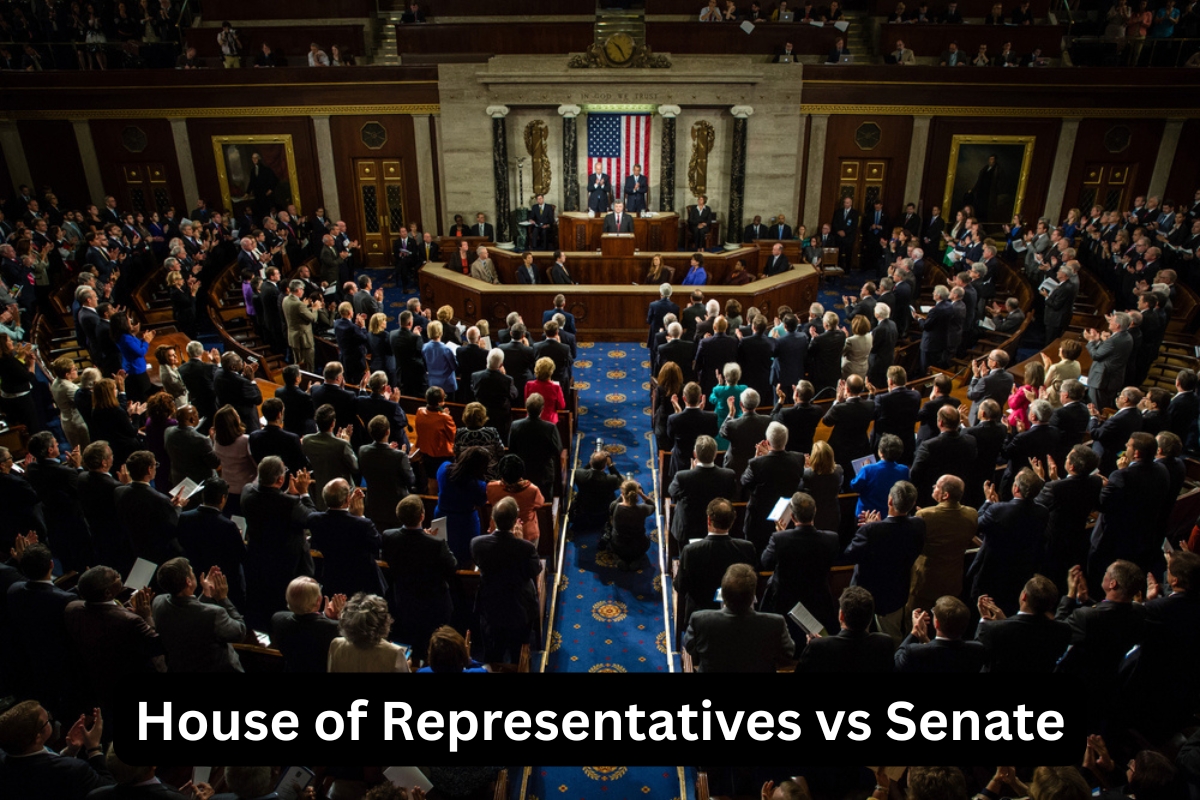
The House of Representatives and the Senate are the two chambers of the United States Congress. Together, they form the legislative branch of the federal government and are responsible for considering and passing federal laws.
Although they share many responsibilities, the House and Senate were deliberately designed to work differently. The House represents Americans largely according to population, while the Senate gives every state equal representation.
They also have different term lengths, membership requirements, procedures, and constitutional powers.
These differences date back to the Constitutional Convention of 1787, when the framers sought a compromise between large and small states over representation in the new federal government.
House of Representatives vs Senate
| House of Representatives | Senate | |
|---|---|---|
| Members | 435 voting representatives | 100 senators |
| Representation | Based on state population | 2 per state |
| Represents | Congressional district | Entire state |
| Term | 2 years | 6 years |
| Minimum age | 25 | 30 |
| Citizenship required | 7 years | 9 years |
| Elections | All regular seats every 2 years | About 1/3 every 2 years |
| Impeachment | Brings articles of impeachment | Conducts impeachment trials |
| Revenue bills | Must originate here | Can amend them |
| Treaties | No advice-and-consent role | Votes on consent to treaties |
| Presidential nominations | No general confirmation role | Considers many nominations |
The House currently has 435 voting representatives, with seats apportioned among the states according to population. The Senate has 100 members, because each of the 50 states is represented by two senators.
What Is the House of Representatives?
The House of Representatives is the larger of the two chambers of Congress. It has been described as the “People’s House” because its structure was intended to keep representatives relatively close to public opinion.
Each representative serves a particular congressional district. The number of House seats allocated to a state depends on its population, although every state is entitled to at least one representative.
Today, there are 435 voting representatives. Representatives serve two-year terms, and regular elections for all House seats occur every two years.
The Constitution requires representatives to be at least 25 years old, to have been U.S. citizens for at least seven years, and to be inhabitants of the state they represent when elected.
What Is the Senate?
The Senate is the smaller chamber of Congress and consists of 100 senators.
Instead of representation being determined by population, every state receives exactly two senators. This means a highly populated state has the same number of senators as a state with a much smaller population.
Also Read: Senate vs Congress
Senators serve six-year terms, considerably longer than the two-year terms of House members. The Senate is divided into three classes, so approximately one-third of its seats are normally contested every two years.
A senator must be at least 30 years old, have been a U.S. citizen for at least nine years, and be an inhabitant of the state represented at the time of election.
Why Are There Two Chambers of Congress?
The differences between the House and Senate originated in one of the most important disputes at the Constitutional Convention of 1787.
Delegates from larger states generally wanted representation to reflect population, while smaller states feared that such a system would leave them with relatively little influence in the national legislature.
Also Read: Senator vs Congressman
The resulting arrangement combined both approaches. States would receive representation according to population in the House of Representatives, while every state would have equal representation in the Senate.
This created the bicameral, or two-chamber, Congress established by Article I of the Constitution.
Representation: The Biggest Difference
Representation is perhaps the easiest way to understand the distinction between the House and Senate.
In the House, representation is based on population. More populous states therefore receive more House seats than less populous states.
In the Senate, every state receives two seats regardless of population.
A representative also speaks for a particular congressional district, whereas a senator represents an entire state.
The system means that the two chambers represent the country in different ways: the House through population-based districts and the Senate through equal representation of the states.
Why Do Representatives Serve Only Two Years?
The framers intended the House to remain particularly responsive to changes in public opinion.
For that reason, representatives received relatively short two-year terms. The House is not considered a continuing body; following elections, a new House organizes itself, elects its Speaker and adopts its rules.
The Senate was designed differently. Its six-year terms were intended to provide greater continuity and stability. Staggering those terms also ensures that only about one-third of senators normally face election at the same time.
Special Powers of the House of Representatives
Although both chambers participate in making laws, the Constitution gives the House several responsibilities that distinguish it from the Senate.
One of the most important concerns revenue legislation. Article I states that bills for raising revenue must originate in the House, although the Senate can propose or agree to amendments.
The House also has the sole power of impeachment. It can approve articles of impeachment against presidents, federal judges and other federal civil officers. Impeachment itself does not remove an official from office; it initiates the constitutional process that can lead to a Senate trial.
Special Powers of the Senate
The Senate has several constitutional responsibilities that the House does not share.
One is its role in considering many presidential nominations. The Senate’s advice-and-consent responsibilities cover appointments including Supreme Court justices, other federal judges, ambassadors and various executive officials.
The Senate also has an important role in treaties. The president negotiates treaties, but the Constitution requires the concurrence of two-thirds of senators present for the Senate to give its consent to ratification.
Finally, when the House impeaches a federal official, the Senate conducts the impeachment trial.
How Do the House and Senate Make Laws?
Despite their differences, the two chambers generally must cooperate for legislation to become federal law.
A bill moves through committees and can be debated, amended and voted upon. For a measure to be presented to the president, the House and Senate must ultimately approve the same version.
If the chambers pass different versions, those differences must be reconciled before both chambers give final approval. The legislation can then be sent to the president, who may sign or veto it.
This system means that neither chamber can ordinarily create federal legislation by acting alone.
Senators Were Not Always Directly Elected
Another important historical difference concerns how senators originally entered office.
Members of the House have been directly elected by voters since the federal government began operating in 1789.
Senators were originally selected by state legislatures, as provided by the Constitution. That changed with the 17th Amendment, ratified in 1913, which established the direct popular election of U.S. senators.
The change made Senate elections more directly democratic while preserving the principle that every state receives two senators.
House vs Senate: An Easy Way to Remember
The simplest distinction is:
The House represents the population, while the Senate represents the states equally.
The House has 435 voting members, serves smaller geographic districts and uses two-year terms. The Senate has 100 members, represents entire states and uses six-year terms.
Their constitutional responsibilities also differ. The House originates revenue bills and has the sole power of impeachment, while the Senate conducts impeachment trials and exercises advice-and-consent powers over treaties and many presidential appointments.
Why the Difference Matters
The House and Senate were not intended to be identical versions of the same institution. Their different structures were built into the Constitution as part of the compromises that shaped the federal government.
The House provides representation tied to population and frequent elections, while the Senate provides equal representation for each state and greater continuity through longer, staggered terms.
More than two centuries after the first Congress convened in 1789, those basic differences remain central to understanding how the United States Congress works.